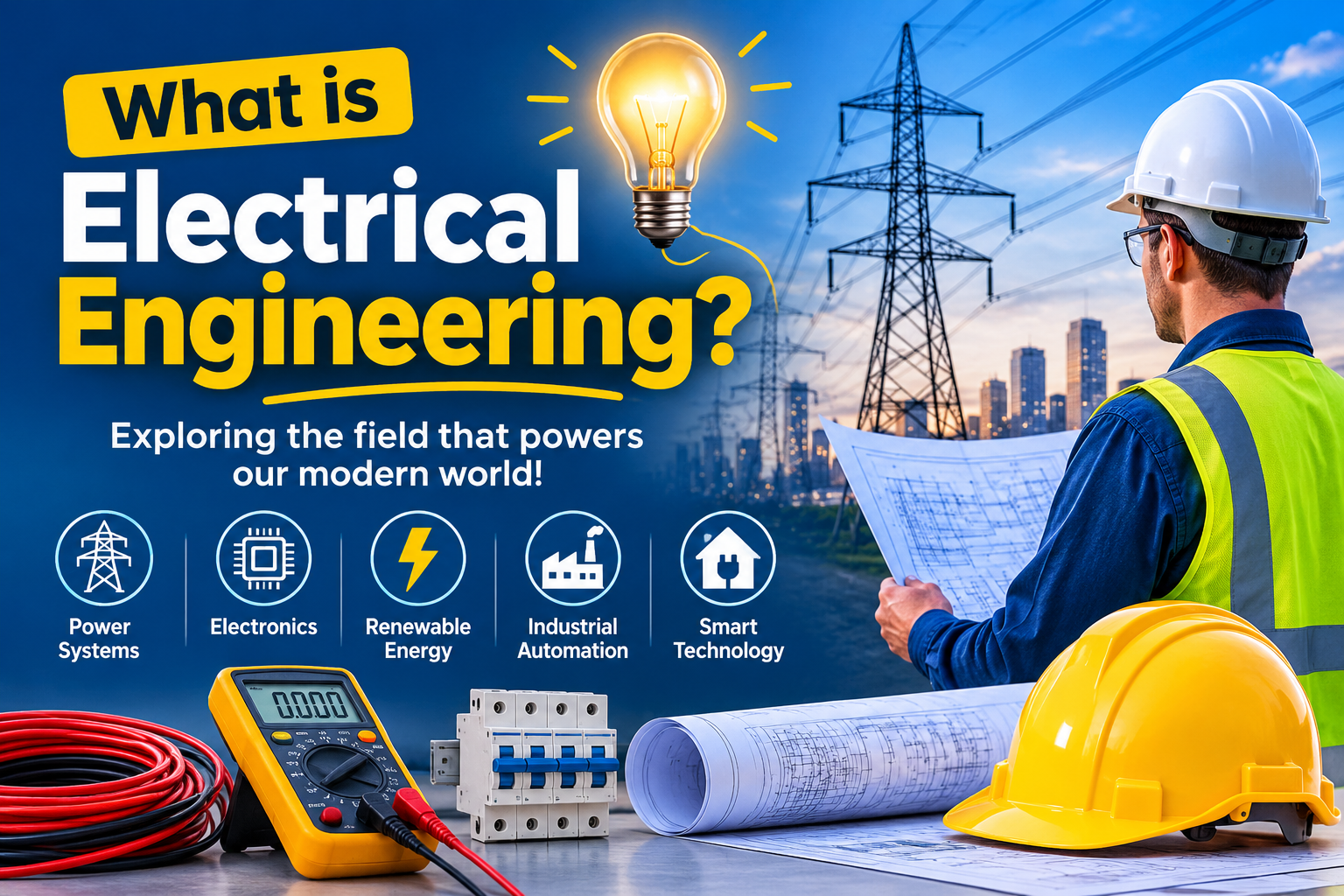
Electrical engineering is one of the most important branches of engineering and plays a major role in modern technology. From electricity generation and power distribution to electrical machines, automation, electronics, and renewable energy systems. Electrical engineers work with technologies that power homes, industries, transportation, communication systems, and businesses.
If you are interested in learning about electricity, electrical systems, motors, transformers, power generation or automation, understanding the fundamentals of electrical engineering is an excellent starting point.
In this guide, we will explain “what electrical engineering is, what electrical engineers do, its major branches, essential skills, career opportunities, and why electrical engineering is important?”
What Is Electrical Engineering?
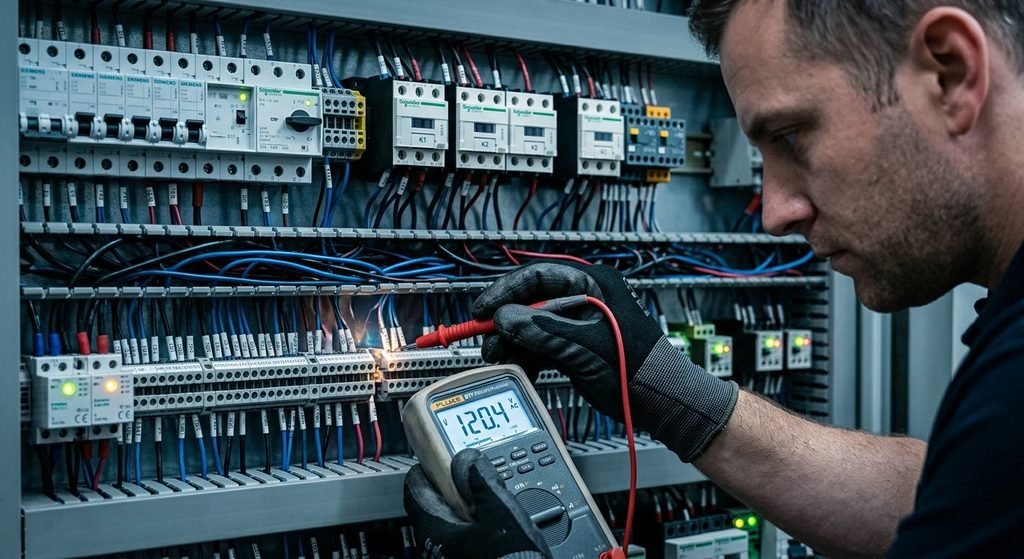
Electrical engineering is a branch of engineering that focuses on the study, design, installation, operation, testing, and maintenance of electrical and electronic systems.
It involves the practical application of electricity, electromagnetism, electronics, and electrical technology to develop systems and equipment that are useful in everyday life and industrial applications.
Electrical engineering covers a wide range of technologies, including:
- Electrical power systems
- Motors and generators
- Transformers
- Electrical wiring
- Control systems
- Automation
- Electronics
- Renewable energy
- Industrial electrical systems
- Power distribution
- Protection systems
- Instrumentation
Electrical engineers can work in power plants, factories, construction projects, manufacturing facilities, telecommunications companies, renewable energy companies, airports, transportation systems, and many other industries.
Why Is Electrical Engineering Important?
Electricity is essential for modern life. Almost every modern facility depends on reliable electrical systems.
Electrical engineering helps us generate, transmit, distribute, control, and use electrical energy safely and efficiently.
For example, electrical engineers contribute to:
- Designing electrical power networks
- Developing industrial control systems
- Installing electrical equipment
- Designing electrical protection systems
- Maintaining motors and generators
- Developing renewable energy systems
- Improving energy efficiency
- Automating industrial processes
- Designing electrical infrastructure for buildings
Without electrical engineering, many technologies and systems used in modern society would not be possible.
Main Branches of Electrical Engineering
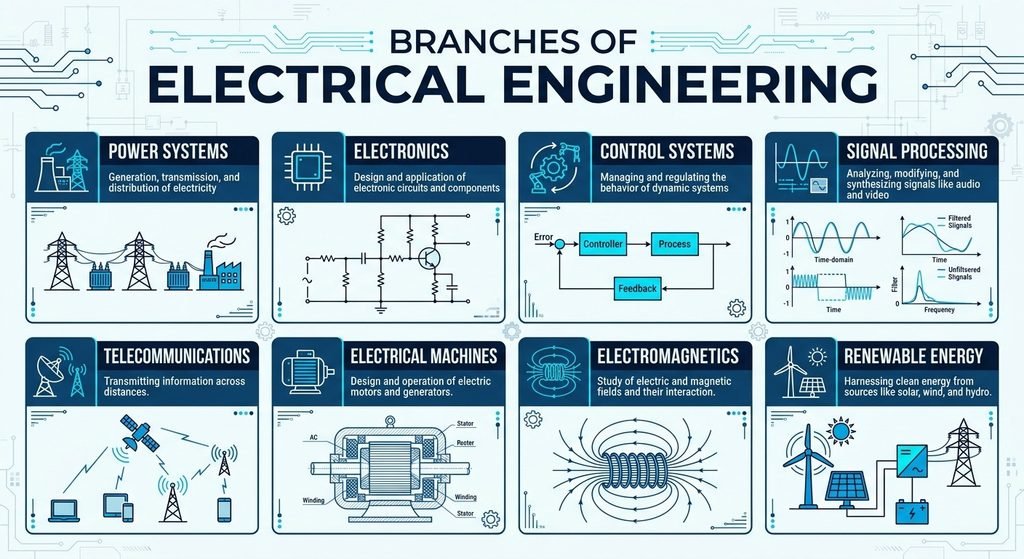
Electrical engineering is a broad field with several specialized areas. Some of the most important branches are explained below:
1. Power Engineering
Power engineering deals with the generation, transmission, distribution, and utilization of electrical energy.
Power engineers work with equipment and systems such as:
- Power generators
- Transformers
- Switchgear
- Circuit breakers
- Transmission lines
- Distribution networks
- Substations
- Protection systems
Power engineering is particularly important for electricity utilities, power plants, industrial facilities, and large infrastructure projects.
2. Electronics Engineering
Electronics focuses on electrical circuits and components used to control and process electrical signals.
Common electronic components include:
- Diodes
- Transistors
- Resistors
- Capacitors
- Integrated circuits
- Sensors
- Microcontrollers
Electronics engineering is widely used in computers, smartphones, medical equipment, communication devices, control systems, and consumer electronics.
3. Control Engineering
Control engineering focuses on controlling machines, processes, and systems automatically.
Control systems are commonly found in:
- Industrial machinery
- Manufacturing plants
- HVAC systems
- Robotics
- Power systems
- Automated production lines
Technologies such as PLC’s, sensors, controllers and SCADA systems are commonly associated with industrial control and automation.
4. Telecommunications
Telecommunications engineering involves the transmission of information through electrical and electronic systems.
It can include:
- Communication networks
- Fiber-optic systems
- Wireless communication
- Radio systems
- Mobile networks
- Signal processing
Electrical engineers in this field help design and maintain systems that allow information to travel between devices and locations.
5. Instrumentation Engineering
Instrumentation involves measuring and controlling physical quantities such as:
- Temperature
- Pressure
- Flow
- Level
- Voltage
- Current
- Speed
Instrumentation systems are widely used in manufacturing plants, power stations, oil and gas facilities, chemical industries and process plants.
6. Renewable Energy Engineering
Renewable energy has become an important area of electrical engineering.
Electrical engineers work with technologies such as:
- Solar photovoltaic systems
- Wind turbines
- Battery storage
- Solar inverters
- Energy management systems
- Hybrid power systems
Solar power systems, in particular, require electrical knowledge to properly design, install, protect and maintain the system.
Basic Concepts in Electrical Engineering
Before studying advanced electrical engineering topics, it is important to understand several fundamental electrical concepts.
Voltage
Voltage is the electrical potential difference that causes current to flow through a circuit.
Voltage is measured in volts (V).
For example: a typical household electrical supply has a specific voltage level designed to operate electrical appliances safely.
Current
Current is the flow of electric charge through a conductor.
Current is measured in amperes (A).
Electrical wires, circuit breakers, switches, and electrical equipment are designed according to the amount of current they need to carry or control.
Resistance
Resistance is the opposition to the flow of electric current.
Resistance is measured in ohms (Ω).
Different materials have different levels of electrical resistance. Electrical resistors are also specifically designed to provide resistance in electronic circuits.
Power
Electrical power represents the rate at which electrical energy is consumed or converted.
Power is measured in watts (W).
Larger electrical systems are often rated in:
- Kilowatts (kW)
- Megawatts (MW)
- Gigawatts (GW)
Understanding electrical power is important when selecting equipment, calculating energy consumption and designing electrical systems.
What Is Ohm’s Law?
Ohm’s Law is a fundamental electrical principle that describes the relationship between voltage, current, and resistance in an electrical circuit. It states that current is equal to voltage divided by resistance, expressed as I = V/R.
The basic formula is:
V = I × R
Where:
- V = Voltage
- I = Current
- R = Resistance
Using Ohm’s Law, you can calculate voltage, current, or resistance when the other two values are known.
For example, if a circuit has a resistance of 10 ohms and a current of 2 amperes:
V = 2 × 10
V = 20 volts
Ohm’s Law is widely used when analyzing electrical circuits and troubleshooting electrical problems.
AC and DC Electricity
Electrical systems commonly use two types of current: AC and DC.
AC Alternating Current
Alternating current periodically changes direction.
AC electricity is commonly used for:
- Household electrical systems
- Industrial power systems
- Power transmission
- Motors
- Large electrical equipment
DC — Direct Current
Direct current flows primarily in one direction.
DC is commonly used in:
- Batteries
- Electronic circuits
- Solar panels
- Battery storage systems
- Portable electronic devices
Understanding the difference between AC and DC is essential for anyone studying electrical engineering.
Electrical Machines
Electrical machines are an important part of electrical engineering. They convert electrical energy into mechanical energy or mechanical energy into electrical energy.
Major electrical machines include:
Motors
An electrical motor converts electrical energy into mechanical energy.
Motors are used in:
- Pumps
- Fans
- Compressors
- Conveyors
- Industrial machines
- Elevators
Generators
A generator converts mechanical energy into electrical energy. Generators are commonly used for backup power and electricity generation.
Transformers
A transformer transfers electrical energy between circuits and can increase or decrease AC voltage.
Common transformer types include:
- Step-up transformers
- Step-down transformers
- Distribution transformers
- Power transformers
Transformers are essential components of electrical power systems.
Electrical Protection Systems
Electrical protection is essential for preventing equipment damage and improving safety.
Common protection devices include:
- Fuses
- MCBs
- MCCBs
- RCCBs
- Circuit breakers
- Relays
- Surge protection devices
These devices can help protect electrical systems from conditions such as short circuits, overloads, leakage currents and other electrical faults.
Proper earthing and grounding are also important parts of electrical safety.
What Does an Electrical Engineer Do?
The responsibilities of an electrical engineer depend on their specialization and workplace.
Typical responsibilities may include:
- Designing electrical systems
- Preparing electrical drawings
- Selecting electrical equipment
- Testing electrical installations
- Troubleshooting electrical faults
- Maintaining electrical equipment
- Supervising electrical projects
- Calculating electrical loads
- Developing control systems
- Inspecting electrical installations
- Improving energy efficiency
- Ensuring compliance with electrical standards
Electrical engineers may also work with electrical technicians, electricians, mechanical engineers, civil engineers, project managers and other technical professionals.
Electrical Engineering vs Electrical Technician
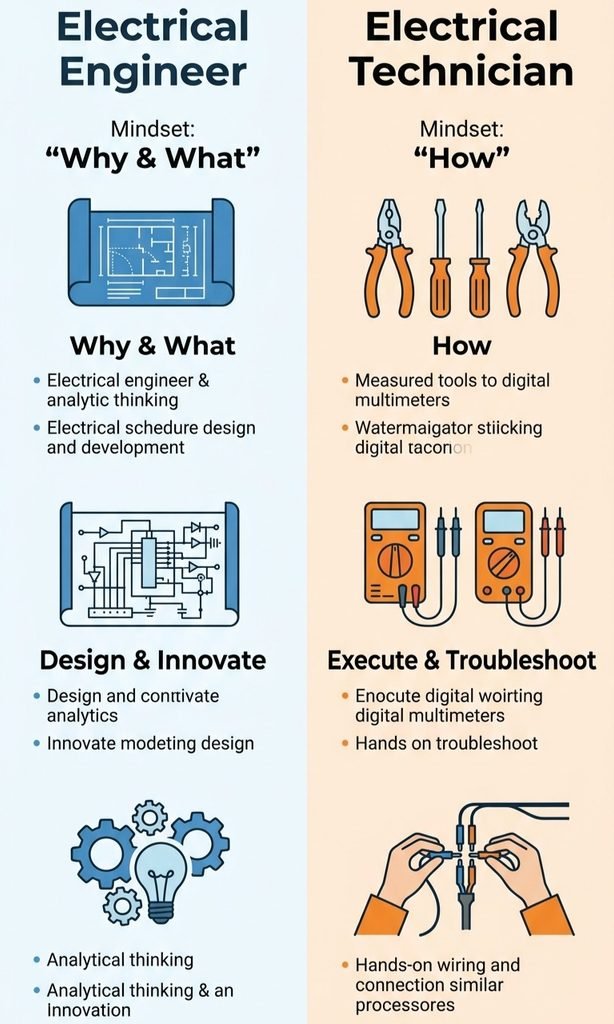
Electrical engineers and electrical technicians often work together, but their responsibilities can be different.
An electrical engineer generally focuses more on design, calculations, planning, system development, project management and technical analysis.
An electrical technician commonly focuses more on installation, testing, maintenance, troubleshooting and practical operation of electrical equipment.
Both roles are important for the successful operation of electrical systems.
Skills Required for Electrical Engineering
A successful electrical engineer needs both technical knowledge and practical skills.
Important skills include:
- Electrical circuit analysis
- Mathematics
- Problem-solving
- Electrical drawing interpretation
- AutoCAD or electrical design software
- Electrical testing
- Troubleshooting
- Control systems knowledge
- Safety awareness
- Project management
- Communication skills
- Technical documentation
Practical experience is especially valuable because electrical engineering involves both theoretical concepts and real-world applications.
Career Opportunities in Electrical Engineering
Electrical engineering offers career opportunities across many industries.
Professionals can work as:
- Electrical Engineer
- Electrical Design Engineer
- Power Engineer
- Maintenance Engineer
- Electrical Project Engineer
- Control Engineer
- Automation Engineer
- Instrumentation Engineer
- Solar Engineer
- Electrical Technician
- Maintenance Technician
- Testing and Commissioning Engineer
Industries that employ electrical professionals include:
- Power generation
- Manufacturing
- Construction
- Renewable energy
- Oil and gas
- Telecommunications
- Transportation
- Aviation
- Automation
- Building services
- Industrial maintenance
How to Start Learning Electrical Engineering
If you are starting your electrical engineering journey, focus on the fundamentals first.
A useful learning path is:
Electrical Basics → Circuit Theory → Electrical Measurements → Wiring → Protection Devices → Electrical Machines → Power Systems → Control Systems → Industrial Automation → Renewable Energy
Start by learning voltage, current, resistance, power, Ohm’s Law, AC/DC systems, circuit diagrams, and electrical safety.
Then gradually move toward practical topics such as multimeter testing, motor control, electrical protection, troubleshooting and electrical system maintenance.
Frequently Asked Questions
What is electrical engineering in simple words?
Electrical engineering is the field of engineering concerned with electricity, electrical systems, electrical equipment, electronics, power generation, control systems and related technologies.
Is electrical engineering difficult?
Electrical engineering can be challenging because it involves mathematics, physics, circuits, and technical concepts. However, learning the fundamentals step by step and gaining practical experience can make the subject much easier to understand.
What are the main branches of electrical engineering?
Major areas include power engineering, electronics, control engineering, telecommunications, instrumentation, automation and renewable energy.
What is the difference between electrical and electronics engineering?
Electrical engineering generally covers larger electrical systems such as power generation, motors, transformers and electrical distribution. Electronics engineering focuses more on electronic circuits, components, signals and low-power systems. However, the two fields overlap in many modern applications.
Can electrical engineering be used in renewable energy?
Yes. Electrical engineering is essential to renewable energy systems such as solar photovoltaic systems, wind power systems, battery storage, inverters and electrical grids.
Conclusion
Electrical engineering is a broad and essential engineering discipline that deals with electricity, electrical systems, machines, power networks, electronics, automation and renewable energy.
From a small electrical circuit to a large power distribution network, electrical engineering principles are used to design, operate, maintain and improve electrical systems.
Learning the fundamentals of voltage, current, resistance, power, circuits, AC/DC electricity, electrical machines, protection devices and electrical safety provides a strong foundation for further study.
Whether you want to become an electrical engineer, electrical technician, maintenance professional, automation specialist or renewable energy professional. Understanding electrical engineering fundamentals is an important first step.
Leave a Reply